Crystal Ballroom (11th floor)
The upper ballroom, with views toward Nob Hill or downtown and plenty of natural light. The club's floor plan draws it long, with rounded ends and a 17-foot ceiling, which changes how I aim the sound.

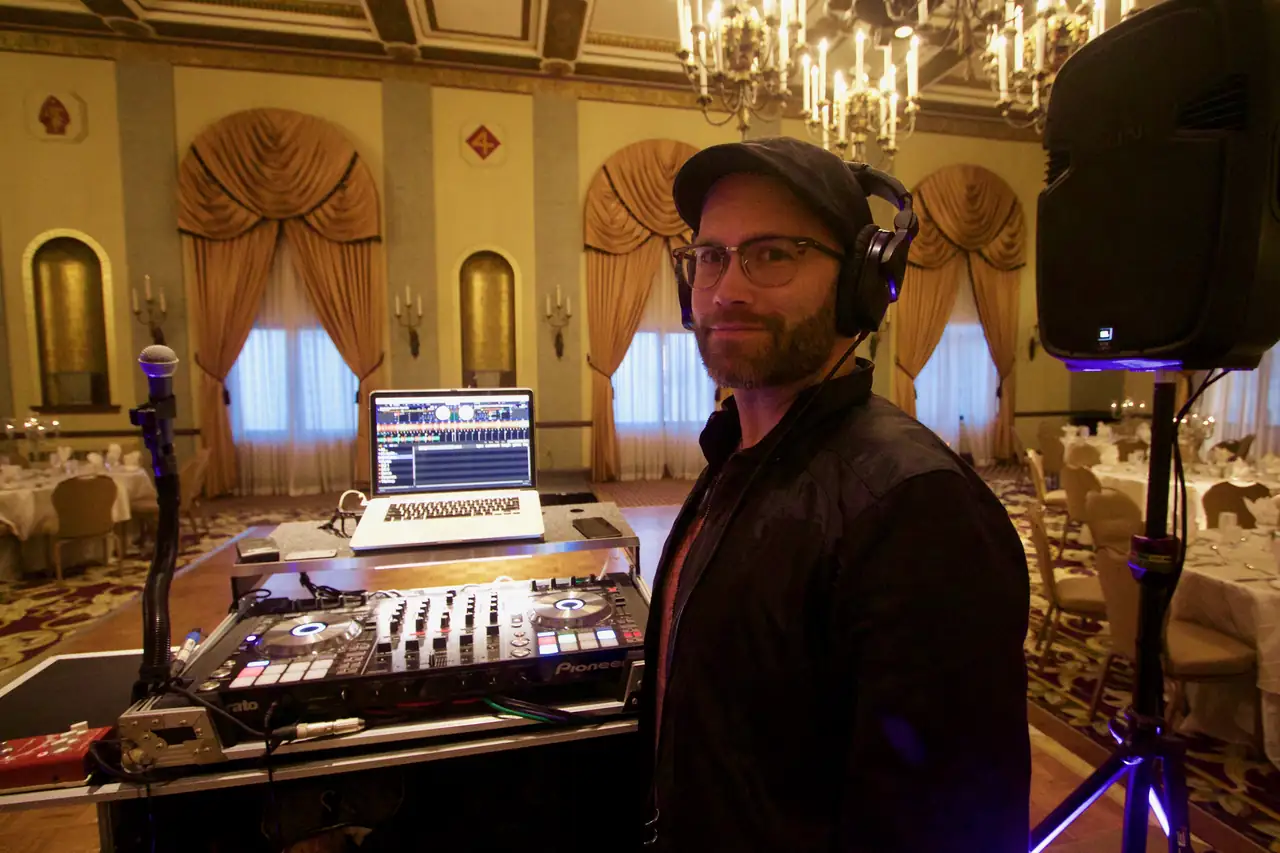
A gala, wedding or dinner here happens on the 10th and 11th floors above Sutter Street, under gold leaf ceilings and original chandeliers, with San Francisco in the windows. I'm the DJ and MC who has the sound, the microphone and the timeline running before your first guest steps off the elevator.
Marines' Memorial Club & Hotel isn't a memorial you only look at. The Marines' Memorial Association, a veterans nonprofit chartered in 1946, runs it as a club and hotel and describes it as the first Living Memorial in the United States. You'll find it at 609 Sutter Street, near Union Square in San Francisco's Theatre District.
The building is older than the club. Bliss & Faville designed it in the 1920s as the Western Women's Club, and the Navy housed WAVES in it during the Second World War. A ship's bell from the USS San Francisco stands in the lobby. You feel all of that when you walk in, and a good night here respects it.
Everything here happens indoors and high up. The event rooms are on the 10th and 11th floors, so every guest and every speaker arrives by elevator. No wind on the microphone. No fog rolling in over the vows. What these rooms ask for instead is control: tall ceilings, a formal mood, and sound that's aimed well instead of turned up.
The upper ballroom, with views toward Nob Hill or downtown and plenty of natural light. The club's floor plan draws it long, with rounded ends and a 17-foot ceiling, which changes how I aim the sound.
Beside the Crystal Ballroom on the same floor, with an 18-foot ceiling and doors onto the foyer where the elevators let your guests out. If your guests gather here before the ballroom opens, it wants its own quiet music, so I plan an additional sound zone instead of pushing one system through a doorway.
Often called the Commandant's Ballroom, one floor down. It's the largest room on the club's floor plan, with a 20-foot ceiling. Before I plan anything I confirm with the club which room is yours, because the booth position, the speaker aim and the walk from the elevator all change with it.
Two more event rooms on the 10th floor. The Heritage Room opens straight into the Commandants Room, so a larger reception can use the two together, and the Rosenberg Room opens off the foyer. A dinner, a toast or a smaller gathering in a room like these calls for a compact setup, one clear microphone and music that stays underneath the talking.
On the 2nd floor. It came with the original building and was an early home of American Conservatory Theater. It has dressing rooms, theatrical lighting, and sound with video projection. If your program or presentation is in the Theatre, I ask the club what the house system covers and plan around it.
A high-rise ballroom is a different job from a lawn or a barn. The weather can't touch you, but the building sets the terms: the elevator, the house sound, the height of the ceiling.
Every case I bring rides an elevator to the 10th or 11th floor, so I don't leave the load-in to chance. I ask the club for the route and the earliest start, then arrive early enough that the rig is built, tested and quiet well before the doors open. The club's clock is in my plan too: a standard event here is five hours, and music ends by 11 p.m. at the latest.
The club says its major function rooms have built-in sound systems. I confirm with the club what the system in your room covers and whether I can tie into it. I still bring my own professional sound, a wireless microphone and backup gear, so the night never depends on one system.
If your evening uses two rooms, say drinks in the Crystal Lounge and dinner in the ballroom beside it, or a ceremony one floor from the party, each gets its own setup. A ceremony gets a speaker aimed at your guests and a wireless mic for the vows. The next room already has music when people reach it.
The club's plan puts the ceilings at 17 feet in the Crystal Ballroom, 18 in the Crystal Lounge and 20 in the Commandants Room, and sound gets lost in that much height if it isn't aimed. I point the speakers at people, keep dinner music at a level you can talk over, and make sure a toast is as clear at the back table as at the head table.
You shouldn't have to spend your own event watching the time or wondering who has the microphone. Before the day I send a planning questionnaire, we talk through the music and the order of the evening, and I plan the timeline to the end time you choose. On the night I'm the MC: entrances, toasts, speakers, a first dance if there is one, the last song, each one announced and cued so you can simply be there.
This is a club with its own house rules. Whatever it needs from an outside DJ before the date, such as proof of insurance and my arrival time, I send it myself, and on the night I work to its rules.
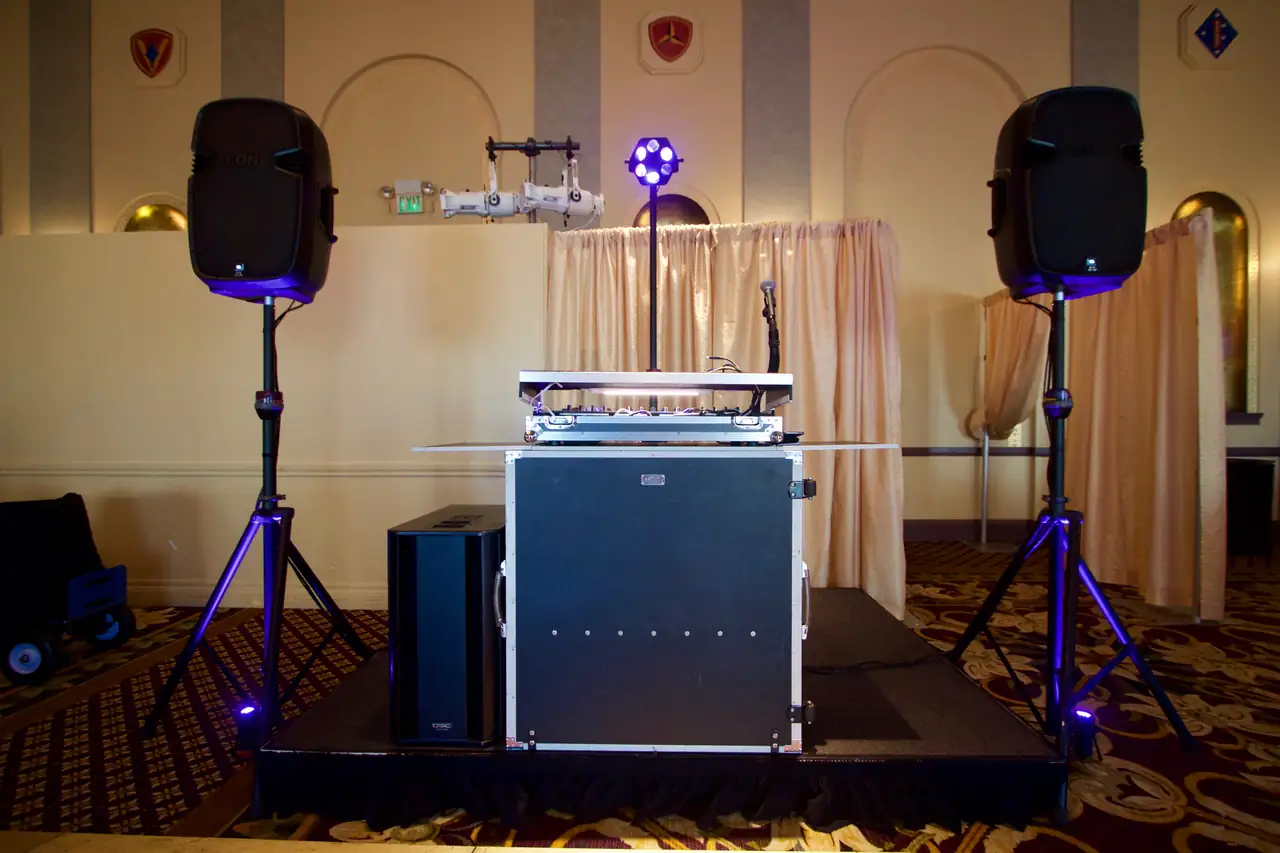
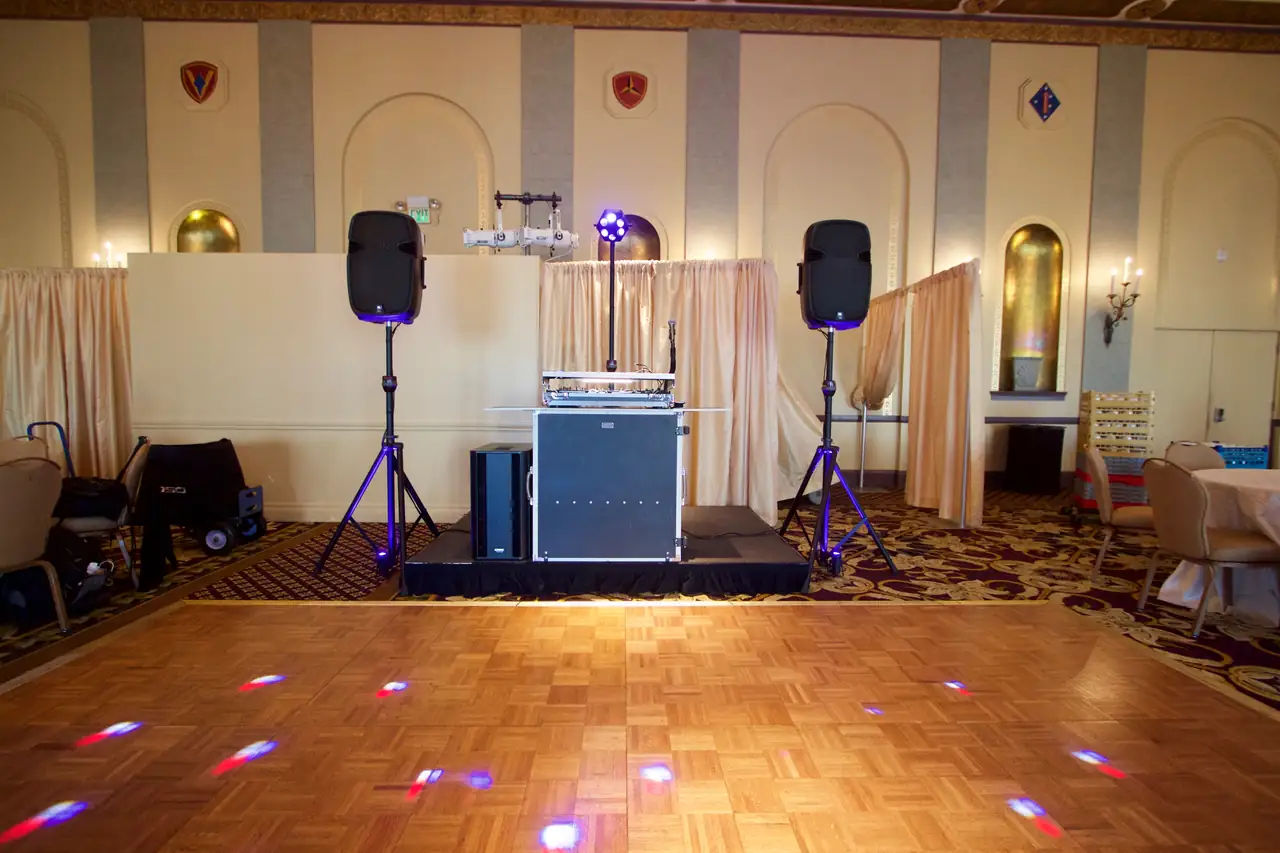
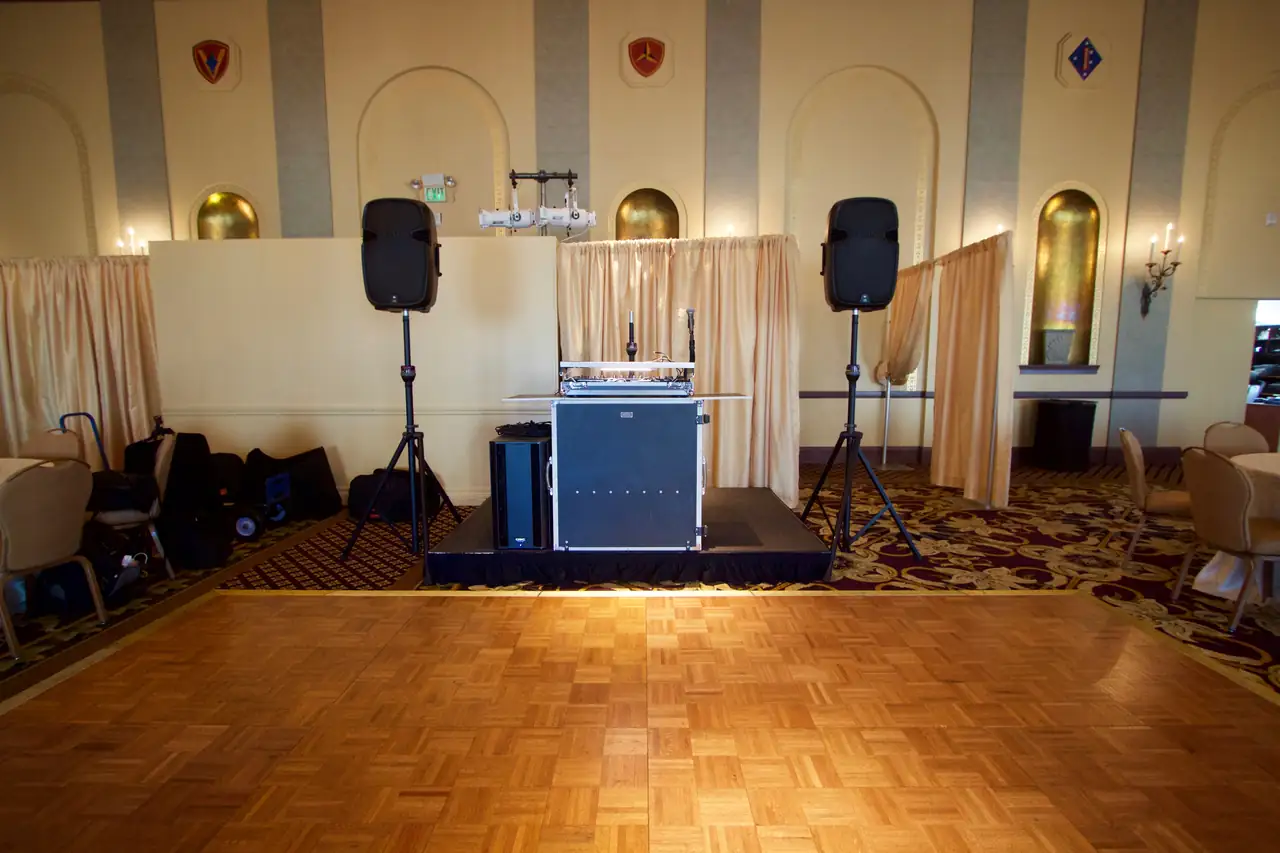
The dance-floor lighting in these photos is mine. A bar of lights sits on a stand above my booth, the speaker stands glow blue at their bases, and one photo shows red, white and blue patterns thrown across the parquet before anyone has stepped onto it. The chandeliers and the gold-lit alcoves along the walls are the club's own, so lighting here should add to that, not fight it.
Warm uplighting along the walls deepens the room once the sun is off the windows. A monogram or pattern projected on the dance floor gives the formal space a center. Dance-floor lighting like mine tells everyone the program is over and the party has started. All of it is optional and you add it in the instant estimate. I check with the club first on what's allowed near the ceilings and chandeliers.
Weddings are only part of what this building hosts. The club is home to Marine Corps Birthday Balls, retirement ceremonies, Fleet Week events, conferences, author talks and lectures. Many of those are events with a program: speakers, a ceremony, a toast that has to be heard. That's MC work as much as DJ work, and I'm both.
I play company galas and holiday parties, milestone birthdays, fundraisers, formal dinners and cocktail receptions, and rooms like these suit all of them. Events are booked through the club's own sales team, which takes proposal requests on its website. There's a hotel in the same building, so guests who stay there are an elevator ride from the party. If you're adding a welcome party or an after-party, a Selector Session suits it: a set of my own programming, up to four hours.
Clubs, festival stages and every venue from Napa Valley to the coast are on one page: Places I've played.
Your date, which room you're in, and the feeling you want when the doors open. The instant estimate gives you a price in a couple of minutes, or book a short call and we'll talk it through. I'll take the questions to the club from there.